Tankless Water Heater Maintenance
Professional Tankless Water Heater Maintenance in Branson, MO
Keep your tankless system running at peak efficiency with annual professional maintenance. We perform descaling, inspections, and system restoration to extend lifespan and maintain reliable hot water flow.
Get a Free Estimate
Why Choose Us
Why Branson Homeowners Choose Us for Tankless Maintenance
Annual maintenance is the insurance policy that keeps your tankless system performing for 20+ years. Here’s what sets 360 Comfort Solutions apart when it comes to professional tankless care.
Protect Your Tankless Investment With Scheduled Maintenance
Annual maintenance keeps your system efficient, reliable, and covered by warranty. Whether you need a one-time tune-up or a multi-year maintenance plan, we’ll help you build a schedule that works for your home.
Our Maintenance Process
How We Maintain Your Tankless Water Heating System
From pre-visit assessment to final documentation, here’s exactly what to expect when 360 Comfort Solutions services your tankless water heater.
Step 1: Pre-Visit Assessment & Hard Water Analysis
Before we arrive, we gather key information about your system and water quality. How old is your unit? When was it last serviced? Have you noticed any efficiency drops, temperature fluctuations, or unusual sounds? We also ask about your water hardness - if you don’t know, we can test it on-site. For customers in particularly hard-water zones (some Branson neighborhoods exceed 300 PPM), we’ll recommend appropriate descaling frequency and may suggest water conditioning to extend intervals. This pre-visit assessment helps us arrive fully prepared with the right supplies and tools.
- Review unit age, brand, and last service date
- Assess household water hardness (PPM) using test strips or historical utility data
- Ask about recent symptoms: temperature changes, efficiency concerns, noise
- Confirm whether previous maintenance included descaling and when
- Discuss seasonal usage patterns and simultaneous demand
- Review current maintenance plan (if any) and discuss gaps or opportunities
Step 2: Safety Check & Visual System Inspection
Our technician performs a complete visual inspection before any work begins. For gas models, we check gas connections for corrosion, verify vent pipe integrity and positioning, inspect the flue damper and heat exchanger housing for visible scale or damage, and confirm proper clearances around the unit. For electric models, we inspect water connections, verify electrical supply integrity, and check for any leaking or corrosion. We also verify that any isolation valves we may have installed during previous service are accessible and functioning. This safety-first approach ensures no hazards exist before service begins.
- Verify gas connections are tight and free of corrosion (gas models)
- Inspect water inlet, outlet, and isolation valve connections for leaks
- Check vent pipe for blockages, damage, or improper slope (gas models)
- Verify electrical plug and cord integrity (electric models)
- Confirm unit is powered off and safe to work on
- Inspect air intake (if applicable) for obstructions or debris
- Test water inlet filter accessibility and condition
- Document unit condition with photos for your maintenance record
Step 3: Descaling Protocol & Heat Exchanger Restoration
If your unit hasn’t been descaled recently, or if we observe efficiency loss, we proceed with professional descaling. This is the core of maintenance work. We isolate the heat exchanger using the isolation valves (or install them if not present), connect our descaling pump and solution tank, and flush the system with manufacturer-approved descaling liquid. We monitor flow rate and chemical concentration throughout. Depending on scale buildup severity, descaling takes 30–90 minutes. After flushing with descaler, we rinse thoroughly with fresh water until the outlet runs clear. We then measure heat exchanger temperature recovery to confirm efficiency restoration. In hard-water areas, this single step can recover 20%+ of lost heating efficiency.
- Install or access descaling isolation valves
- Connect descaling solution supply and circulation pump
- Run descaling solution through heat exchanger for 30–90 minutes
- Monitor flow rate and chemical concentration
- Perform interim rinses to remove dissolved minerals
- Measure outlet water temperature rise before and after descaling
- Document efficiency recovery percentage
- Flush system thoroughly with clean water until outlet runs crystal clear
- Dispose of descaling solution per environmental guidelines
Step 4: Component Testing & Calibration
Once descaling is complete, we run a comprehensive test suite. We measure incoming water pressure (must remain 20+ PSI for reliable operation). We check flow sensor response by briefly blocking inlet water and confirming the unit reacts appropriately. We measure outlet water temperature across low, medium, and high flow rates to confirm stability. For gas models, we test ignition by cycling the unit through startup and shutdown. We measure combustion efficiency and vent draw using a combustion analyzer. For electric models, we verify heating element function by confirming temperature rise. We also test temperature sensor calibration and confirm the unit’s safety shutdown works when flow drops below minimum threshold.
- Measure incoming water pressure at low, medium, and high flow
- Test water inlet filter condition and flow path clearance
- Verify flow sensor response to water demand changes
- Measure outlet water temperature stability across 15-minute full-load cycle
- Check temperature setpoint accuracy and adjustment range
- Test ignition sequence and pilot function (gas models)
- Perform combustion analysis and vent draw measurement (gas models)
- Verify safety shutdown activates when flow drops below threshold
- Check display panel for error codes or warning lights
- Document all measurements in your maintenance report
Step 5: System Education, Documentation & Planning
Before we finish, we review findings with you. We explain what we found, what we did, and what it means for your system’s health and efficiency. If descaling recovered significant efficiency, we show you the before-and-after temperature rise measurements. If we spot early signs of wear (like a sensor reading slightly off-specification), we’ll flag it and recommend preventive replacement before failure. We discuss water conditioning options if your water hardness is very high. We leave you with a detailed maintenance report, photos of your unit, and a recommendation for next-year’s service. If you don’t yet have a maintenance plan, we discuss how a plan can save money on future service and extend system life.
- Walk you through all findings and measurements
- Explain efficiency recovery (if descaling was performed)
- Show before-and-after temperature and efficiency numbers
- Discuss water conditioning benefits if hardness is 200+ PPM
- Provide written maintenance report with service date and next-recommended date
- Leave photos of unit condition for your records
- Explain seasonal adjustments (summer/winter setpoints) if applicable
- Discuss preventive component replacement if wear is detected
- Review maintenance plan options and enrollment benefits
- Answer all questions about system operation and longevity
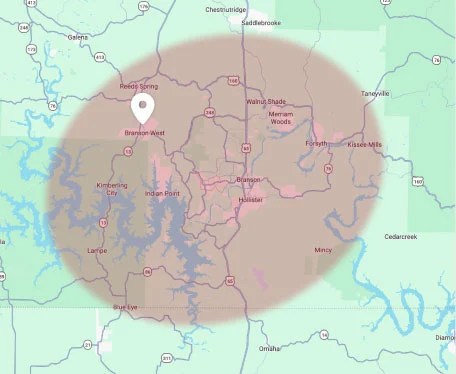
Don’t See Your Location?
We may still be able to help! Give our team a call today to see if we service your neighborhood, and we’ll be happy to assist you.
Service Areas
Tankless Water Heater Maintenance Service Areas in Southwest Missouri
We provide professional tankless maintenance across the Branson region and surrounding communities - from our home base out to the smaller communities along the Table Rock Lake corridor.
Proudly Serving Our Communities Around:
Other Locations We Serve:
Explore More
Complete Tankless System & Water Heating Care
A well-maintained tankless system performs best as part of a complete home comfort strategy. Explore the related services we provide for homes and businesses across the Branson area.
Tankless Installation & Replacement
When upgrading or replacing your system, we handle sizing, installation, and full commissioning with comprehensive testing.
Explore Tankless Installation & ReplacementTankless Repair & Emergency Service
When problems arise, we diagnose and repair fast with same-day service availability and honest assessment.
Explore Tankless Repair & Emergency ServiceTank Water Heater Services
We also install and maintain traditional tank water heaters with the same professional care.
Explore Tank Water Heater ServicesWater Conditioning & Softening
Hard water damages tankless systems. Water softening reduces descaling frequency and protects your investment long-term.
Explore Water Conditioning & SofteningFurnace Maintenance & Tune-Up
Complete home comfort requires attention to both heating and hot water. We bundle services for efficiency.
Explore Furnace Maintenance & Tune-UpFinancing Options
Maintenance plans are affordable. Flexible financing spreads costs over time while protecting your system.
Explore Financing OptionsYour Tankless Maintenance
Keep Your Tankless System Running Efficiently for 20+ Years
A properly maintained tankless water heater is one of your home’s best long-term investments. Annual professional maintenance removes mineral scale, extends system lifespan, maintains efficiency, and keeps your warranty coverage active. The difference between a well-maintained system and a neglected one is often 5–10 extra years of reliable service and thousands of dollars in energy savings. Our 40+ years of hands-on experience means we understand Branson’s hard-water challenges intimately. Call us to schedule your annual maintenance and let us build a plan that fits your home’s needs and your budget.
Questions & Answers